Artificial intelligence in companies is going beyond just predictive models or chat-based assistants. Companies are progressively implementing AI agent systems that not only can reason through tasks but also interact with tools and make decisions over several steps. With the rise of such agentic systems, a basic architectural decision is posed: Is it better to have open agents or closed agents?
Knowing this difference is essential to understanding how it impacts system reliability, security, scalability, and long-term flexibility. This blog clarifies the meaning of open and closed agents, their differences, and how to decide on the best architecture for your case.
Understanding AI Agents
An AI agent is more than a language model responding to a prompt. Agents are designed to:
Interpret goals
Plan actions
Use tools or APIs
Execute tasks across workflows
For example, an agent may receive a business objective, retrieve relevant data, analyse it, generate insights, and trigger downstream actions. The extent to which an agent can explore, adapt, and connect to external systems defines whether it is considered open or closed.
An AI agent is not just a language model that answers a prompt. Agents have the capability to:
Understand objectives
Plan a strategy
Use tools for APIs
Execute tasks through different workflows
As a matter of fact, an agent can get a corporate goal, get the necessary data, analyse it, create the insights, and then send the commands to the other systems. How much an agent can discover, adjust, and link with the outside world determines if it is an open or closed one.
What Are Closed Agents?
Closed agents function within very limited areas. They are built to carry out particular tasks by using an already established set of resources and rules. Their conduct is deliberately limited so that there is less unpredictability and risk.
In a closed-agent system, the developers have a clear understanding and definition of:
Which tools can the agent access
the actions that the agent is allowed to perform
how the decisions are checked
At what point is the approval of a human necessary
Due to these restrictions, closed agents can be more easily tested, observed, and controlled. Their outputs are more predictable, so they can be used in environments where precision and compliance are of primary importance.
Closed agents are commonly used in areas such as customer support automation, internal IT operations, financial reporting, and healthcare workflows. In these contexts, a controlled system reduces the risk of unintended actions or incorrect decisions.
What Are Open Agents?
Open agents emphasise adaptability and autonomy in their design. Rather than depending on a pre-defined set of rules, they are capable of selecting tools on their own, trying different approaches to a problem, and changing their behaviour according to the environment.
An open agent may:
Discover new APIs or data sources
Collaborate with other agents
Re-plan tasks when conditions change
Operate with minimal human intervention
Such a flexible model makes open agents compatible with complicated or ever-changing problems, for example, tasks like research, strategic analysis, or system orchestration. Nevertheless, the higher autonomy level also brings some issues. Open agents are less predictable, harder to supervise, and more secure, especially when they communicate with the external systems.
Therefore, companies employing open agents need to put a lot of resources into observability, logging, access control, and safety features.
Also Read: What are Agentic AI Systems? How They Differ from Traditional AI
Key Differences at a Glance
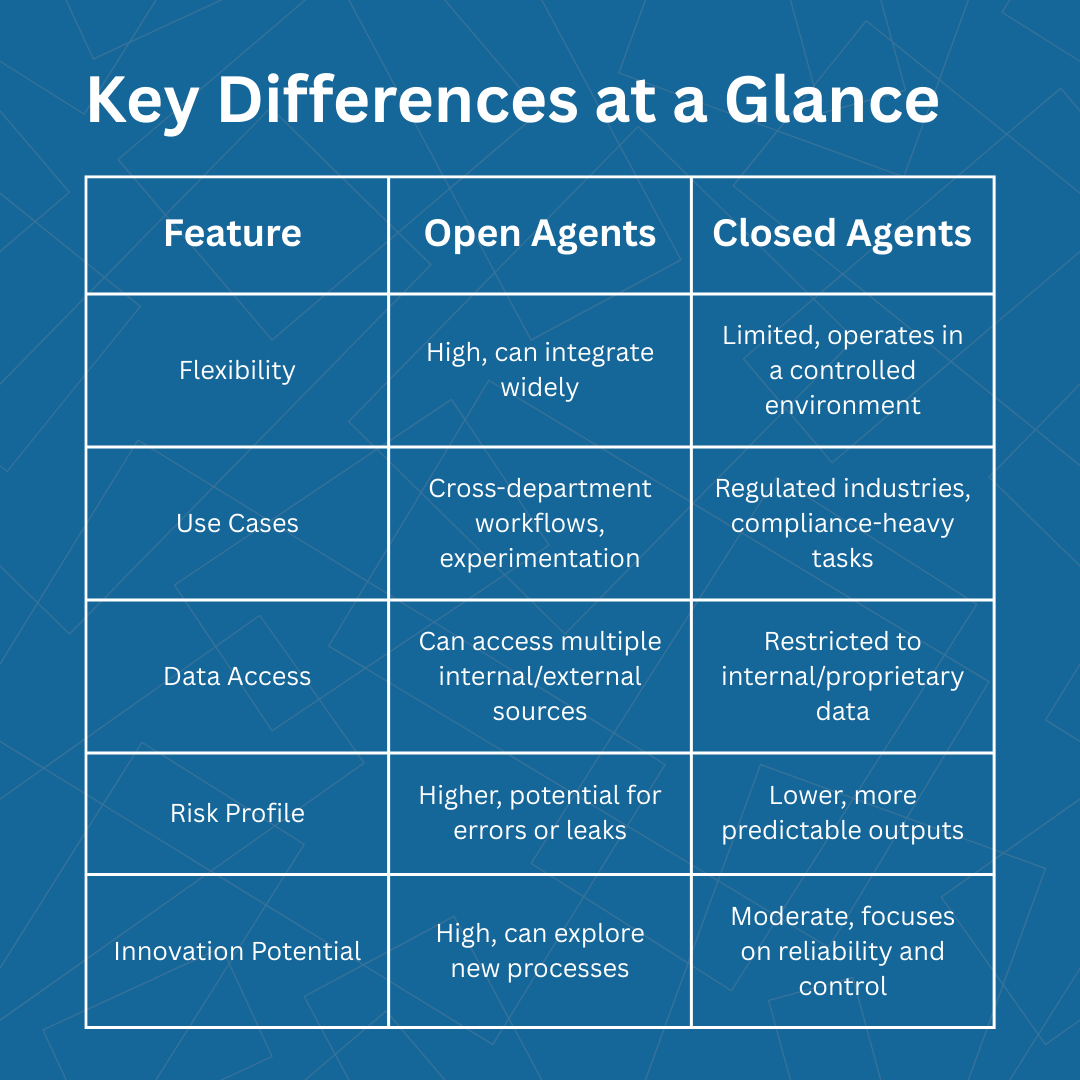
Closed agents are typically deterministic or semi-deterministic, while open agents may follow non-linear paths to reach a goal. This difference has major implications for debugging, accountability, and trust.
Choosing the Right Architecture
Choosing between open and closed agents depends on a number of practical factors.
Firstly, the regulatory environment should be taken into account. For instance, highly regulated industries like finance, healthcare, and government usually get the most out of closed-agent architectures. Such systems make it easier to show compliance and enforce consistent behaviour.
Secondly, the stability of the workflow should be determined. In case business processes are changed frequently or need creative problem-solving, open agents might bring more value. For stable and repetitive tasks, closed agents are usually adequate and more reliable.
Thirdly, the cost of failure should be assessed. In situations with a high impact, for example, financial transactions or patient care, where mistakes can be very costly, closed agents should be preferred. They lessen the risk by restricting the system's capabilities without supervision.
At last, organisational maturity should be considered. Open agents necessitate advanced monitoring, incident response, and governance practices. Teams that do not have these abilities may find it difficult to manage open systems effectively.
Also Read: Agentic AI vs. Generative AI: A Clear Guide to the Key Differences
Hybrid Approaches in Practice
Not many companies decide on solely open or closed architectures. Rather, they implement hybrid agent systems.
In a hybrid model:
Core operational tasks are managed by closed agents
Exploratory or analytical tasks are handled by open agents
Human supervision is used for high-risk decisions
The combination of these layers enables the company to keep the benefits of both approach the freedom to innovate and the control to safeguard the critical parts of the system.
Also Read: What Are AI Agents? And 6 Types of AI Agents with Examples
Conclusion
Open and closed agents signify two extremes of an architectural spectrum. Closed agents guarantee stability and control, whereas open agents entail flexibility and adaptability. It is not that one way is better than the other - the suitable decision depends on the context, the level of risk that can be tolerated and the goals for the future.
Knowing these compromises upfront, companies have the opportunity to create agentic systems that have the strength to perform various functions and at the same time maintain safety, extend easily and remain in agreement with business needs.
FAQs: Open Agents vs Closed Agents: Choosing the Right Architecture
1. What’s the main difference between open and closed agents?
Closed agents operate through a set of predefined rules and tools, whereas open agents adapt their behaviour dynamically and select tools autonomously.
2. Are open agents riskier?
Yes. Higher autonomy without strong guardrails can lead to increased security and operational risk
3. Which industries prefer closed agents?
Finance, healthcare, government, and other regulated sectors.
4. When should open agents be used?
For complex situation and variable workflows such as research, analysis, and system orchestration.
5. Can both architectures work together?
Yes. Most enterprises use hybrid systems, closed agents for core tasks, open agents for innovation.